


On 1 May 2026, the most widely used tool in a landlord’s legal kit will disappear. For more than three decades, Section 21 of the Housing Act 1988 has allowed landlords in England to end a tenancy without giving a reason. From that date, it is gone.
Every existing assured shorthold tenancy automatically becomes a periodic assured tenancy. The only route to possession becomes Section 8, which requires landlords to prove a specific legal ground in court.
This is the biggest change to private renting since 1988. It affects every landlord in England, whether you own one flat in Barnet or a portfolio across London. The practical consequences are real. Evictions will be slower, more expensive, and more contested. Insurance cover that was a nice-to-have is now essential.
This guide walks through three things every landlord needs to understand about the section 21 abolition: what you can still do before 1 May 2026, what the new grounds actually require, and how to protect your income against the longer possession process now arriving.
What’s Actually Changing on 1 May 2026
The Renters’ Rights Act 2025 received Royal Assent on 27 October 2025. The Government has confirmed 1 May 2026 as the “big bang” Commencement Date. Almost every change lands on that single day.
Here is what that means in practice:
- Landlords cannot serve any new Section 21 notice from 1 May 2026 onwards.
- The last valid day to serve a Section 21 notice is 30 April 2026. For first-class post, this practically means serving by 28 April.
- Every existing assured shorthold tenancy automatically converts to an assured periodic tenancy. Fixed terms end. The tenancy rolls month to month.
- No new fixed-term tenancies can be granted after 1 May 2026.
- Tenants gain the right to leave at any time with two months’ notice.
- Landlords must give all existing tenants the official Government Information Sheet by 31 May 2026. Missing this deadline risks a civil penalty of up to £7,000, rising to £40,000 for continued breach.
The Information Sheet must be downloaded from the official GOV.UK page. Downloading it from anywhere else risks invalidating it.
The Final Window for Section 21

Landlords still have a narrow window to rely on Section 21, but it is closing fast.
A Section 21 notice served before 1 May 2026 remains usable, but the claim for possession must be filed at court by 31 July 2026. After that date, the notice is dead, regardless of when it was served.
This means landlords should review their portfolios now. If there is a property you know you will want to recover, refurbish, or sell in the next twelve months, Section 21 is the faster, cleaner route. Waiting until the spring risks missing the window entirely.
A practical example. A landlord in Barnet has a tenant on a fixed-term AST expiring in August 2026. The landlord wants to sell. Serving a Section 21 notice in February 2026 gives the tenant two months’ notice and leaves time to file at court before the 31 July deadline. Waiting until May 2026 means relying on Ground 1A under Section 8, which carries a four-month notice period and a twelve-month protected period at the start of the tenancy.
The difference is months of rental income and a far simpler legal process. For landlords with longer-standing tenancies, a review of your residential property cover at the same time is worthwhile.
Section 8 Becomes the Only Route
Once Section 21 is gone, Section 8 of the Housing Act 1988 is the only way to recover possession. It is a fundamentally different process.
Section 8 requires landlords to cite a specific statutory ground, evidence it, and present the case at court. Grounds fall into two categories:
- Mandatory grounds: the court must grant possession if the ground is proven.
- Discretionary grounds: the court may grant possession if it considers it reasonable.
From 1 May 2026, landlords must use the new prescribed Form 3A. Deposit protection is a pre-condition for most grounds, with anti-social behaviour the main exception. Misusing a ground, for example claiming to sell a property and then re-letting it, carries a Rent Repayment Order of up to two years’ rent.
The Grounds Most Landlords Will Actually Use
The section 21 abolition makes these the grounds that matter:
- Ground 1 (landlord or close family moving in): four months’ notice, twelve-month protected period at the start of the tenancy, and a twelve-month re-letting ban after possession.
- Ground 1A (landlord selling): four months’ notice, same twelve-month protected period, same twelve-month re-letting ban.
- Ground 8 (rent arrears, mandatory): three months of arrears required (up from two), with four weeks’ notice. Universal Credit delays must be disregarded in the calculation.
- Grounds 10 and 11 (discretionary arrears): useful as a back-up when Ground 8 conditions are not quite met.
- Grounds 7A and 14 (anti-social behaviour): strengthened, possession can be sought immediately.
- Ground 4A (students): new ground for HMO student lets only, with four months’ notice.
If you run a student HMO, it is worth reviewing your HMO cover at the same time, as the new student ground only applies to qualifying properties.
Why Evictions Are Going to Take Much Longer
Landlords need to plan for longer timelines, higher costs, and more contested cases.
Ground 8 rent arrears cases typically take three to six months from notice to possession order. In London and other high-demand areas, seven to nine months is realistic once court backlogs are factored in. Goodlord’s 2025 data found that 43 percent of sole lettings agents have never served a Section 8 notice. The learning curve is steep.
A realistic example. A tenant falls three months behind on rent. The landlord serves a Section 8 notice citing Ground 8, waits four weeks, files the claim, and waits for a hearing date. Possession is granted, a bailiff warrant is obtained, and the tenant eventually leaves. Realistic timeline: six to nine months. Realistic lost rent: £6,000 or more on a modest London property, often with little chance of recovery.
The financial impact is why rent protection cover has moved from optional to essential. Contested cases, complex evidence requirements, and judicial discretion all push timelines out further.
The Other Changes Landlords Can’t Ignore
The section 21 abolition sits alongside a wider package of reforms.
- Rent increases only once per year, via a Section 13 notice using the new Form 4A, with two months’ notice. Tenants can challenge the proposed rent at the First-tier Tribunal.
- Rental bidding is banned. Landlords and agents cannot accept offers above the advertised rent.
- Tenants have a contractual right to request a pet, which landlords cannot unreasonably refuse.
- Discrimination against tenants on benefits or with children is explicitly banned.
- Rent in advance is capped at one calendar month, and no rent can be demanded before the tenancy is signed.
- A PRS Database is planned for a regional roll-out from late 2026. A PRS Landlord Ombudsman is likely to follow in 2028.
For landlords with commercial lets or mixed portfolios, the rules differ. Our guidance on commercial property cover and block of flats arrangements sets out how different property types are affected at renewal.
What This Means for Landlord Insurance
Longer possession timelines, tighter regulation, and bigger financial exposure all change the insurance picture. A policy that was adequate in 2023 may not be fit for purpose in 2026.
- Rent guarantee insurance is now essential. Cover should start from the first missed payment, include legal costs for Section 8 proceedings, and last long enough to cover a realistic six to nine month timeline.
- Legal expenses cover solicitor costs, court fees, and bailiff enforcement.
- Unoccupied property cover becomes more relevant. Void periods will stretch during contested possessions, and the twelve-month re-letting ban after Ground 1A use leaves properties empty for long stretches. Check your unoccupied property cover terms carefully, particularly the maximum void period permitted.
- Landlord liability matters more under the new regime. Stronger tenant protections mean more exposure to claims if maintenance obligations are not met. Review your landlord’s liability cover.
- Listed buildings and period properties bring their own complications, especially if refurbishment is needed between tenancies. Listed building cover should be reviewed alongside the tenancy changes.
- Property developers and portfolio landlords should check that their property developers insurance reflects the longer void periods now likely between tenancies.
What Landlords Should Be Doing Right Now
The landlords who come through the section 21 abolition well are the ones acting as soon as possible.
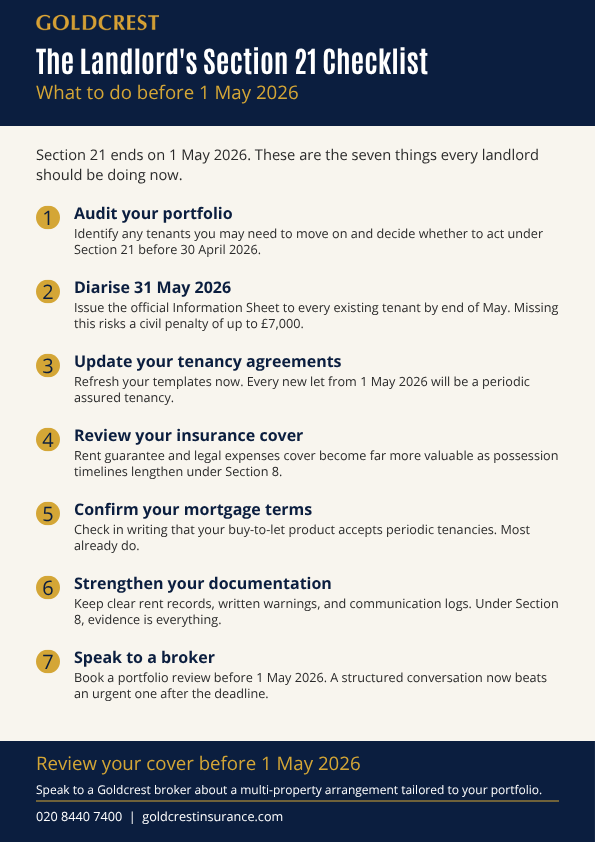
A practical checklist:
- Audit your portfolio. Identify any tenants you may need to move on and decide whether to act under Section 21 before 30 April 2026.
- Diarise 31 May 2026 for issuing the official Information Sheet to every existing tenant.
- Update your tenancy agreement templates for new lets from May onwards.
- Review rent guarantee and legal expenses cover at your next renewal.
- Confirm your mortgage product accepts periodic tenancies. Most already do, but check in writing.
- Strengthen documentation. Keep clear rent payment records, written warnings for breaches, and communication logs. Under Section 8, evidence is everything.
- Speak to a broker about a portfolio review before 1 May 2026. A structured conversation now beats an urgent one after the deadline.
For landlords with several properties, a single multi-property arrangement is often more efficient than a scatter of individual policies. Our brokers can talk you through the options and help you request a callback or get a tailored quote.
The Key Takeaways for Landlords

The section 21 abolition is not a soft change or a distant one. It is a hard deadline of 1 May 2026, with every existing tenancy converting on the same day and no transitional exceptions for those who did not prepare.
Section 8 is workable, but it is slower, more technical, and more expensive than Section 21. Ground 8 for rent arrears and Ground 1A for selling will be the most commonly used routes, and both carry longer notice periods and stricter evidence requirements. The twelve-month re-letting ban on the selling ground makes it a serious commitment, not a casual one.
Insurance cover now needs a portfolio review rather than a renewal rubber-stamp. Rent guarantee, legal expenses, and unoccupied property cover have all moved up the priority list. Landlords with the right cover and the right preparation will navigate the new rules. Those who leave it to May will not.
To review your cover before the deadline, contact us and speak directly to one of our brokers.
Frequently Asked Questions
Can I still serve a Section 21 notice in April 2026?
Yes, up to 30 April 2026. For first-class post, this practically means serving by 28 April. The claim for possession must be filed at court by 31 July 2026, or the notice becomes invalid.
What happens to my existing fixed-term tenancy on 1 May 2026?
It automatically converts to an assured periodic tenancy. The fixed term ends, and the tenancy rolls month to month. You do not need to issue a new agreement, but you must provide the official Information Sheet by 31 May 2026.
Can I evict a tenant for rent arrears under the new rules?
Yes, under Ground 8, but the tenant must be at least three months in arrears at both notice and hearing. Notice period is four weeks. Universal Credit delays are disregarded in the calculation.
What if I want to sell my rental property?
You can use Ground 1A, but only after the tenancy has run for twelve months. Notice period is four months. If possession is granted, you cannot re-let the property for twelve months after the notice expires. Breaching this risks a Rent Repayment Order of up to two years’ rent.
Do I need to change my insurance cover?
Possibly. Longer possession timelines make rent guarantee and legal expenses cover far more valuable. Void periods after Ground 1A use are now significant. A broker review before 1 May 2026 is the sensible step.