


Picture the scene. A Ferrari 296 GTB is pulling off the A406 when another driver clips the rear quarter. The damage looks modest. The carbon monocoque does not agree. Within days, the owner is being asked how the car should be valued, who should inspect it, and whether the settlement they are being offered bears any resemblance to what they paid.
This is the moment most owners discover an uncomfortable truth. Standard motor insurance is built for standard cars. When a £500,000 vehicle is written off, the process is slower, more technical, and far more consequential than a typical claim. The difference between the right policy and the wrong one can run into hundreds of thousands of pounds.
This guide walks through exactly what happens when a high value car is written off, why specialist cover matters, and how owners in London, Barnet, and the wider UK can protect themselves long before an incident occurs.
What Does “Written Off” Actually Mean for a High Value Car?
A car is classed as a total loss, or written off, when the cost of repairs plus the salvage value exceeds the sum the insurer is prepared to pay. For a standard vehicle, that threshold is usually reached when repairs hit 50 to 60 percent of the car’s value. For a supercar or luxury saloon, specialist insurers will often approve repairs well beyond that, sometimes up to 90 or 100 percent, in order to preserve the car’s integrity.
A write-off does not automatically mean the vehicle is destroyed. What happens next depends on the salvage category assigned by the engineer.
The Four Salvage Categories Explained
The Association of British Insurers uses four categories under its 2017 code. You can read the full definitions on GOV.UK.
- Category A: Scrap only. The entire car, including parts, must be crushed.
- Category B: The body shell must be crushed, but some parts can be salvaged for reuse.
- Category S: Structural damage, but the car can be repaired and returned to the road.
- Category N: No structural damage. The car can be repaired.
The category matters because it affects resale, future insurability, and whether the owner can buy the car back. A Category S Porsche 911 GT3 RS will never command the same value as a clean-history equivalent, even after a flawless repair.
Agreed Value vs Market Value: The Most Important Distinction
 This is where most high value car insurance write off disputes begin.
Standard insurers settle total losses using market value. They rely on trade guides such as Glass’s, CAP HPI, and Parker’s. These guides work well for mainstream cars. They fall apart above £200,000. They cannot account for low mileage, bespoke specification, limited-edition runs, or appreciation.
Agreed value is different. At policy inception, the owner and insurer agree a figure in writing, supported by valuations, photographs, and provenance documentation. If the car is written off, that figure is what the insurer pays. No dispute, no guide-based haggling.
Consider a hypothetical owner of a McLaren Senna written off after a low-speed collision. With agreed value cover at £750,000, the settlement could be paid in full within weeks. Under a standard market value policy, the offer might have landed closer to £550,000. That is a £200,000 swing on a single clause.
Agreed value needs annual review. Cars like the McLaren 765LT and 992-generation GT3 RS have held or grown their value sharply in recent years. A policy set eighteen months ago may now leave the owner significantly underinsured. Specialist high net worth car insurance is built around this reality.
The Claims Process Step by Step
The process for a £500k write-off runs in a fairly predictable sequence, though the timelines are longer than most owners expect.
- Notification and recovery. The car is moved on covered transport to a specialist storage facility, not a local pound.
- Initial assessment. An engineer trained on that specific manufacturer’s vehicles inspects the car, often working alongside the manufacturer’s approved network such as Ferrari Classiche, Porsche Classic, or Bentley Mulliner.
- Repair versus total loss decision. The engineer weighs up repair costs, parts availability, and structural integrity.
- Settlement negotiation. Agreed value policies move quickly. Market value policies tend to stall here.
- Salvage and buy-back. Owners can usually exercise a right to repurchase the salvage, which appeals to collectors and owners of rare cars.
- Replacement or payout. Many high net worth policies offer new-for-old replacement if the car is written off within the first one to three years from registration.
- Diminution in value. Even after a perfect repair, the car’s resale value drops. Some specialist policies cover this loss.
Expect four to twelve weeks for a high value claim, compared with two to four for a standard vehicle. Complex valuations, parts lead times, and engineer availability all add to the timeline.
The Complications Most Owners Don’t Anticipate
Every claim has its quirks. High value car insurance write off cases have more than most.
- Finance and leasing. PCP, HP, and lease agreements complicate settlement. GAP insurance bridges the gap between the insurer’s payout and the outstanding balance, which matters when the finance house is the legal owner.
- Parts availability. Post-Brexit delays on imported components now stretch to weeks or months, and industry estimates suggest repair costs have risen significantly in recent years.
- Battery damage on electric hypercars. Rimac Nevera and Lotus Evija write-offs have been driven by battery pack costs that can exceed £200,000 on their own.
- Theft, unrecovered. Range Rover, Mercedes G-Wagon, and Lamborghini Urus are among the most targeted vehicles. Industry data suggests recovery rates for stolen high value cars are low, with most exported within days.
- Overnight location clauses. If the car is parked somewhere other than the declared address, cover can lapse entirely.
- Underinsurance. Deliberately insuring for less to reduce premiums leads to averaging at claim time, where the insurer cuts the settlement proportionally to reflect the shortfall.
Owners in Hampstead, Mayfair, St John’s Wood, and parts of Barnet have seen clusters of organised theft through 2024, particularly of keyless-entry supercars. Goldcrest’s celebrities house and car insurance and professional footballers car insurance are built around exactly these risks, with cover calibrated for the postcodes where they bite hardest.
Flood is another risk that catches owners off guard. A Bentley Continental GT immersed in flood water can be written off Category B due to irreparable electrical damage, even when the bodywork looks intact. With agreed value cover reflecting any bespoke commission, the settlement matches the true cost of a like-for-like replacement.
Why Standard Motor Insurance Falls Short
Comparison sites are built for volume. They cannot properly rate a car above £200,000, and they rarely offer agreed value as standard. Claims handlers at volume insurers are not supercar specialists. They may insist on an approved repairer that has never touched a carbon monocoque.
The Financial Ombudsman Service handles a substantial volume of motor insurance complaints each year, with valuation disputes forming a significant share. For an owner of a £500k car, that is not a statistic. That is the difference between getting on with life and spending six months arguing over a figure.
Specialist brokers know the approved repair networks, the right valuation process, and the policy clauses that decide whether a claim is paid in full. If you hold a classic car insurance policy alongside modern supercars, the same logic applies. Different cars, different risks, different valuation methods.
How to Protect a £500k Car Before Anything Goes Wrong
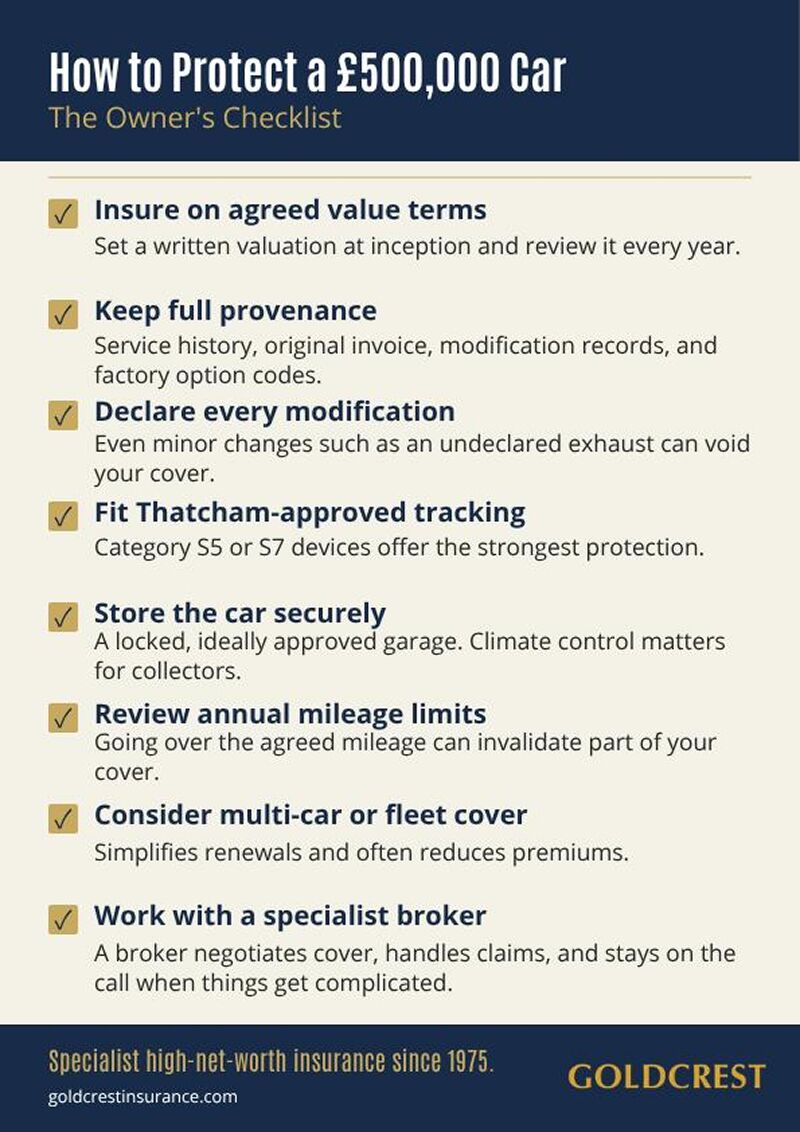
The owners who come through a write-off well almost always share a checklist. None of it is complicated. All of it matters.
- Insure on agreed value terms, and review the figure every year.
- Keep full provenance: service history, original invoice, modification records, factory option codes.
- Declare every modification, however minor. An undeclared exhaust can void cover entirely.
- Fit a Thatcham-approved tracking device, ideally Category S5 or S7.
- Store the car in a secure, ideally approved garage. Climate control matters for collectors.
- Review annual mileage limits. Going over can invalidate part of the cover.
- Consider a multi-car arrangement or a fleet insurance policy if you own several vehicles. It simplifies renewals and often reduces premiums.
- Work with a broker, not a direct-to-consumer insurer. A proper broker negotiates cover, negotiates claims, and stays on the call when things get complicated.
If you own a home and a collection that together run into seven figures, it is worth reviewing your high net worth household insurance at the same time, so the whole estate is covered on a consistent basis.
For owners with a commercial angle, for example cars registered to a business or run through a company fleet, mini fleet insurance can be a more efficient route than individual policies.
Clients frequently ask us what else matters at renewal. Our recent piece on insurance for sports and entertainment professionals covers the reputational and lifestyle angle that sits alongside the hardware.
Frequently Asked Questions
How long does it take to settle a write-off claim on a £500k car?
Typically four to twelve weeks, compared with two to four weeks for a standard vehicle. The timeline depends on valuation complexity, parts availability, and whether the figure is disputed.
Will I receive a brand-new replacement?
Many high net worth policies offer new-for-old replacement if the car is written off within the first one to three years of registration. Outside that window, settlement is usually a cash payout based on agreed value.
Can I buy my car back from the insurer after a write-off?
Yes, in most cases. Owners can exercise a buy-back right and repurchase the salvage, which is common with collectors and limited-edition models.
What’s the difference between agreed value and market value?
Agreed value is a figure set and documented at policy inception, and paid in full at total loss. Market value relies on trade price guides that rarely reflect the true worth of cars above £200,000.
Does a write-off affect the value of other cars on my policy?
It can affect future premiums across a multi-car policy, particularly if the loss was theft-related. Specialist high net worth insurers tend to handle this more favourably than volume insurers.